


What Is the Difference Between a Lip Lift and Lip Filler?
September 22, 2026
At What Age Should a Deep Plane Facelift Be Performed?
September 22, 2026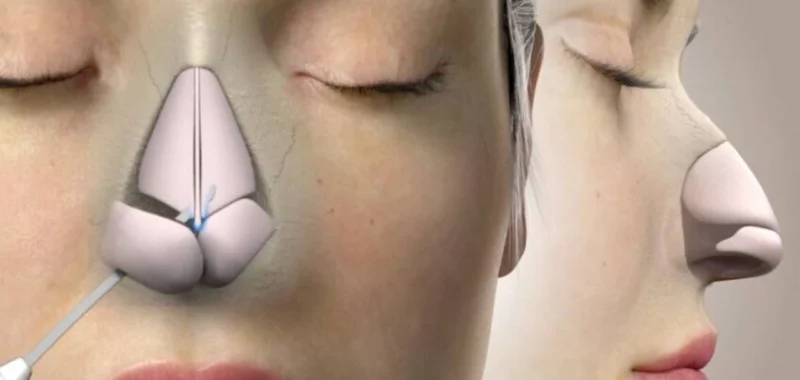
When a patient is shown an edited version of their own photo during a rhinoplasty consultation, the first thought is usually the same: “Will I really look like this after surgery?”
The nasal hump may have been reduced, the tip slightly lifted and the profile made more balanced. The change on the screen takes only a few seconds, and the patient sees themselves with a different nose for the first time.
But this is exactly where the most important point about rhinoplasty simulations begins:
A simulation is not a photograph of the surgical result.
Used correctly, it is a very valuable planning tool that makes communication between the surgeon and the patient easier. Misinterpreted, however, it can create expectations of a result that is not actually achievable.
For this reason, photo simulations before rhinoplasty should not be seen as a “guarantee of results”, but as a visual draft that allows the surgeon and the patient to talk about the same aesthetic goal.
Why Can’t the Nose on the Screen and the Nose After Surgery Be Exactly the Same?
Changing the shape of a nose in a photograph and performing surgery on living tissue are completely different things.
Digitally reducing the nasal bridge by a few millimetres, lifting the tip or narrowing the nostrils can be done in seconds.
In real rhinoplasty, however, the surgeon shapes a living anatomy that works together with bone, cartilage, skin, connective tissue, muscles and breathing function.
Moreover, the process does not end when the surgery is over.
The tissues heal, swelling develops and subsides, and the skin adapts to the new nasal framework. The person’s individual healing characteristics can also affect the final appearance.
It is not possible to predict all of this perfectly in a photo simulation.
A simulation should not say “this is exactly how you will look after surgery”. The more accurate question is: “Is a change in this direction suitable for your face?”
So Why Are Rhinoplasty Simulations Used?
Because in rhinoplasty, the words the patient uses and the change the surgeon understands are not always the same.
For example, a patient may say: “I’d like my nose to be a little smaller.”
But “a little smaller” is a rather vague description.
Does the patient want the hump reduced? The tip made smaller? The nose to project less from the face? Or to look narrower from the front?
A simulation on a photograph helps translate these abstract expectations into a visual language.
The patient may say “I don’t want my tip to be this upturned” or “this change in profile feels more natural to me”.
The surgeon can then explain which expectations are anatomically realistic.
In this respect, the real value of a simulation lies not so much in predicting the future as in clarifying communication.
Can Every Nose That Looks Good in a Simulation Be Achieved With Surgery?
No.
This is one of the most important limitations of the digital environment.
There are no anatomical limits in a photo editing program. The nose can be made as small as desired, the tip lifted as much as desired, or the profile completely changed.
In surgery, there is no such freedom — and there shouldn’t be.
The supporting cartilage structures of the nose must be preserved, the skin must be able to adapt to the new structure, and breathing function must not be compromised.
For example, a very small nose may look attractive in a digital image, but the person’s anatomy may not be suitable for that degree of reduction.
In Op. Dr. Behçet Şahin’s approach to rhinoplasty, the goal is not to copy the image on the screen at any cost. When assessing the harmony of the nose with the face, aesthetic appearance and functional structure must be preserved together.
Why Can Saying “I Want Exactly This Nose” Be a Problem?
During rhinoplasty consultations, patients sometimes show a photo of another person or a nose they have seen on social media as a reference.
These photos can be useful for understanding a person’s aesthetic expectations.
However, a nose that looks beautiful on another face may not have the same effect on yours.
Because the appearance of the nose is perceived together with:
- the shape of the forehead,
- the distance between the eyes,
- the cheekbones,
- the lip structure,
- chin projection,
- the length of the face.
Applying the same nose shape to two different faces can produce completely different results.
That is why the aim of modern rhinoplasty planning is not to “copy a reference nose”, but to design a nose that suits the person’s own face.
What Can Be Assessed Most Realistically in a Photo Simulation?
A simulation is particularly valuable for understanding the direction of the change. For example, in a profile view, it is possible to roughly assess how reducing the hump might affect the face, how changing the position of the tip might alter the balance of the profile, or how the relationship between the nose and the chin will be perceived.
However, you should not assume that millimetre-level details in the photo will be exactly the same after surgery.
When looking at a simulation, rather than asking “Will my nose look exactly like this?”, it is a healthier approach to ask:
“Does this direction of change suit my face?”
Why Can Profile Simulations Look More Impressive?
Because the outer contour of the nose is clearly visible in a profile photo, the changes made easily catch the patient’s attention.
Reducing the hump, changing the position of the tip or adjusting the nasolabial angle is visually easy to understand in profile.
But the nose is a three-dimensional structure.
In real life, people do not only see your nose in full profile.
They see it from the front, at an angle, from above and from constantly changing angles while you speak.
That is why creating a beautiful profile alone is not enough for successful rhinoplasty planning.
Why Is the Frontal View Harder to Predict?
From the front, many more variables affect the aesthetic appearance of the nose.
The width of the nasal bones, the structure of the tip cartilages, skin thickness, the nostrils and existing asymmetries all play a role in the result.
Especially in noses with thick skin, it is not possible to predict precisely with a digital simulation to what extent subtle changes to the framework will be reflected on the skin surface.
For this reason, the aim of frontal simulations should not be to create a perfect picture of the result, but to show the general direction of the planned change.
Does Thick Skin Affect How Realistic a Rhinoplasty Simulation Is?
Yes.
One of the important factors that determine the outcome of rhinoplasty is the characteristics of the skin and soft tissue.
Thin skin can show changes in the underlying bone and cartilage structure more clearly. Thick skin, on the other hand, can mask very fine details, especially at the tip, and postoperative swelling may last longer.
In the digital environment, however, the skin can be edited as if it will reveal every change with the same precision.
Therefore, especially in patients with thick skin, creating an image of a nasal tip that is sharper and finer than can be achieved anatomically may not create realistic expectations.
Are AI-Generated Nose Simulations Reliable?
With the development of AI-powered image generation tools, patients can now create very realistic aesthetic changes on their own photos.
These images can be very convincing visually.
However, looking photorealistic does not mean that something is medically achievable.
AI cannot assess a person’s cartilage quality, septal structure, airway, the tissues beneath the skin or the anatomical limitations that may be encountered during surgery the way a physical examination can.
So a photo of an “ideal nose” created with AI may serve as a reference to communicate aesthetic preferences, but it should not replace a surgical plan.
Can a Simulation Show Breathing Problems?
No. A photo simulation can show the external appearance of the nose, but it cannot assess breathing function.
Yet when planning rhinoplasty, looking only at the external shape of the nose is not enough.
Septal deviation, the nasal valve area, the turbinates and other anatomical features that may affect the airway must also be evaluated.
Making a nose look smaller digitally is easy. In surgery, however, the airway must be preserved while the nose is reduced.
That is why an aesthetic simulation and a functional assessment cannot replace each other.
Is It Right to Compare the Result With the Simulation After Surgery?
They can be compared to a certain extent, but turning this into a “test of success” is not right.
Especially in the first weeks or months after surgery, comparing the nose with the simulation can be misleading because of swelling.
It can take months for the final appearance of a rhinoplasty to emerge. In areas such as the tip, changes may continue for even longer.
So in the second month after surgery, it may still be too early to say:
“The nose in the simulation didn’t look like this.”
More importantly, a simulation should never be used as a promise of an identical result in the first place.
What Should a Good Rhinoplasty Simulation Look Like?
Perhaps the best simulation is not the one that looks the most beautiful, but the one prepared within the most realistic limits.
An image that dramatically changes the patient’s face may be impressive at first glance. But if it is not surgically achievable, its value for planning decreases.
A good simulation should:
- preserve the person’s own facial proportions,
- not create an excessively reduced nose,
- not ignore the limits of the skin structure,
- show harmony with the rest of the face,
- not offer the patient a promise of a definite result.
During a simulation, it is just as important for the surgeon to be able to say “this change may not be right for your anatomy” as it is to say “we can do this”.
Should a Simulation Be Used to Choose a Surgeon?
There is an important point to keep in mind here.
A patient who receives simulations from different clinics will naturally compare the images and may want to choose the surgeon who created the digital nose they like most.
However, one cannot conclude that the person who prepares the most beautiful simulation necessarily creates the most appropriate surgical plan.
When researching rhinoplasty in Turkey, in addition to the simulation, you should also consider the surgeon’s rhinoplasty experience, their approach to natural results, whether they carry out a functional assessment, whether they explain anatomical limitations to the patient, and the postoperative follow-up system.
A simulation can be prepared in a few minutes. Real rhinoplasty requires surgical experience and anatomical judgement developed over many years.
Simulation Has a Different Advantage for Patients Travelling to Turkey From Abroad
In medical tourism, photo simulations have another function: reducing the distance.
A patient who does not live in Turkey may not be able to have their first consultation in person at the clinic. During an online preliminary assessment based on photographs, an initial discussion can take place about the patient’s facial proportions and expectations.
For example, while the patient may think their nose is “too big”, the surgeon can explain that the main issue is not just the size of the nose, but that the position of the tip, the balance of the profile or the relationship between the chin and the nose also affect the overall look.
Here, the simulation can create a shared visual language.
However, it is important to know that such online assessments in medical tourism do not replace a face-to-face physical examination.
When the patient arrives in Turkey, the structure of the nose is physically examined, and the surgical plan is finalised based on this examination.
How Should You View Simulations When Researching Rhinoplasty in Turkey?
Especially if you are travelling from another country for surgery, the sense of confidence a digital simulation gives can be very strong.
Seeing your own face with the nose you want can make the decision easier.
But when choosing a surgeon, there is something more important than the image on the screen: having it explained to you why that image was created and within what limits.
“This is what your nose will look like” and “we can plan a change in this direction on your face, but the result will be shaped by your skin and anatomical characteristics” are not the same approach.
For patients planning rhinoplasty in Turkey as medical tourists, setting realistic expectations also helps them better prepare for the long recovery period they will go through after returning to their home country.
So What Should You Ask Yourself When Looking at a Simulation?
When you see the simulation, don’t focus only on whether the nose looks beautiful. Consider the following:
- Does this nose still look like me?
- Does it look balanced with my other facial features?
- Is the change too much, or does it look natural?
- Why is the surgeon recommending these changes?
- Is there a change I want that is not anatomically recommended?
- How is my breathing function taken into account in this plan?
These questions turn the simulation from “choosing a result from a shopping catalogue” into a real surgical planning tool.
The Most Realistic Simulation Is Sometimes the One That Shows Less Change
The more flawless the image prepared before rhinoplasty looks, the higher the patient’s expectations become. Yet the goal of rhinoplasty is not to design the smallest, most upturned or most flawless nose possible in the digital world.
The goal is to create a natural, balanced and functional nose on a real face, to the extent that the real bone, cartilage and skin structure allow.
For this reason, in rhinoplasty assessments with Op. Dr. Behçet Şahin, the simulation is treated not as a commitment to a result, but as a communication tool that allows the patient and the surgeon to compare their expectations.
Perhaps the feeling a good simulation should give the patient is not “I will definitely look like this after surgery”.
A more accurate feeling would be:
“I can now explain better what kind of change I want, and my surgeon can explain to me how much of that change is realistic for my face.”
In the decision for rhinoplasty, this shared understanding is far more valuable than a change of a few millimetres on the screen.