


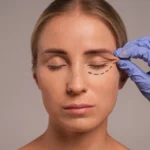
Is a Younger, Fresher Look Possible with Eyelid Aesthetics?
November 3, 2025
Rhinoplasty is one of the most critical steps in facial aesthetics because the nose is located right at the center of the face, and the balance it provides directly affects the entire expression. One of the biggest motivations for people to undergo rhinoplasty is to achieve a natural look. Therefore, proper planning of rhinoplasty, designing in accordance with the person's facial proportions, and preserving the functional structure are of great importance.
Why Is a Natural Appearance Important?
Today, the understanding of aesthetics has largely changed. Noticeable, artificial, and incompatible noses are now giving way to natural lines and structures that harmonize with the person's facial expressions. The goal in rhinoplasty is not just to downsize the nose or change its shape; the overall structure of the face, the person's character, skin type, and breathing function are also taken into consideration.
A detailed evaluation prior to nose surgery is essential to achieve a natural result. In this evaluation, the jawline, forehead structure, lip angle, and overall symmetry of the face are examined. Since every individual's nasal structure is different, the results must also be personalized.
How Is Rhinoplasty Planned?
Pre-operative planning is highly valuable for a successful outcome in rhinoplasty. At this stage:
-
The patient's expectations are understood
-
Facial proportions are analyzed
-
Breathing tests are performed if necessary
-
A detailed evaluation is created through photos
This stage ensures proper planning of the surgery from both an aesthetic and functional perspective. Nose designs that are unsuitable for the person's face, excessively curved, or incompatible with the face disrupt the natural look.
Preservation of Breathing Function
A natural appearance is not just about the shape; correct breathing is also a part of nasal function. Because even if a beautiful appearance is achieved after rhinoplasty, the patient will feel uncomfortable if breathing becomes difficult.
Therefore, during the surgery:
-
Septum deviations are corrected
-
Structures causing obstruction are removed
-
The normal flow of the airway inside the nose is preserved
This is as much a procedure that elevates the quality of life as it is an aesthetic touch.
The Recovery Process and Settling of the Result
Recovery after rhinoplasty varies depending on the individual. Generally:
-
The splint is removed in the first week
-
Bruising and swelling subside in 7–10 days
-
The nose clearly reveals its shape in the first 3 months
-
Full settling takes 6–12 months
Over time, the nose harmonizes with the natural structure of the face. Being patient is important during this process.
Who Is It Suitable For?
Rhinoplasty is suitable for individuals who desire a more balanced appearance on their face, experience breathing problems, or have a nasal shape that negatively affects their facial expressions. Patients seeking a natural result are much more satisfied with surgeries planned by expert ENT surgeons.